How to Automate Driver Check-In at Your Warehouse
 Roman Reynebeau|Founder, Matilda Technologies|
Driver check-in is one of the first things that happens when a truck arrives at your facility, and at most warehouses, it's still one of the most manual. A driver pulls up to the gate, waits in line, interacts with a guard or receptionist, hands over paperwork, and waits again while someone confirms their appointment and assigns a dock. On a busy day, that process alone can take 15 to 30 minutes before the driver even enters the yard.
That delay sets the tone for the entire visit. It backs up traffic at the gate, pushes dock schedules off track, and adds dwell time that leads to detention fees. And it happens with every single truck, every single day.
The good news is that driver check-in can be fully automated. Facilities that have made the switch are processing drivers in minutes instead of half an hour, with no guard required and no manual data entry.
What manual driver check-in actually looks like
At most facilities, check-in involves a guard shack or a receptionist window at the gate. The driver stops, provides their name, carrier, load information, and sometimes a physical ID. Someone on staff verifies the information, confirms there's a dock available, and assigns them a door. The driver gets verbal or written instructions and proceeds into the yard.
This process has a few obvious problems. It requires dedicated staff at the gate for every shift. It's only as fast as the person working the window. It creates a single point of failure where one slow interaction backs up every truck behind it. And the data captured is inconsistent, often handwritten or entered into a spreadsheet after the fact.
When volume is low, it works well enough. But as facilities grow and truck traffic increases, manual check-in becomes the bottleneck that limits how fast the entire operation can move.
How automated driver check-in works
Automated driver check-in replaces the guard shack with a combination of hardware and software that lets drivers check themselves in with minimal or no human interaction. There are several approaches, and the best facilities use them together.
Self-service kiosks
A kiosk at the gate lets drivers check in by entering their information on a touchscreen. The system validates the driver against expected appointments, confirms their load details, and assigns a dock. The driver gets their assignment on screen and proceeds into the yard. No guard needed, no phone calls, no waiting for someone to look up their appointment.
Kiosks work well for facilities that handle a mix of scheduled and walk-in traffic. They're simple enough for any driver to use without training, and they capture consistent, accurate data for every check-in.
Mobile check-in
Some facilities allow drivers to check in from their phone before they even arrive. Unlike a traditional driver check-in app, there's no download or account creation required. The driver receives a link via SMS, completes check-in on their mobile device, and by the time they reach the gate, the system already knows who they are and where they're going.
Mobile check-in is particularly effective for reducing gate congestion because the check-in process happens before the driver reaches the facility. There's no line, no stop, and no interaction at the gate at all.
License plate recognition
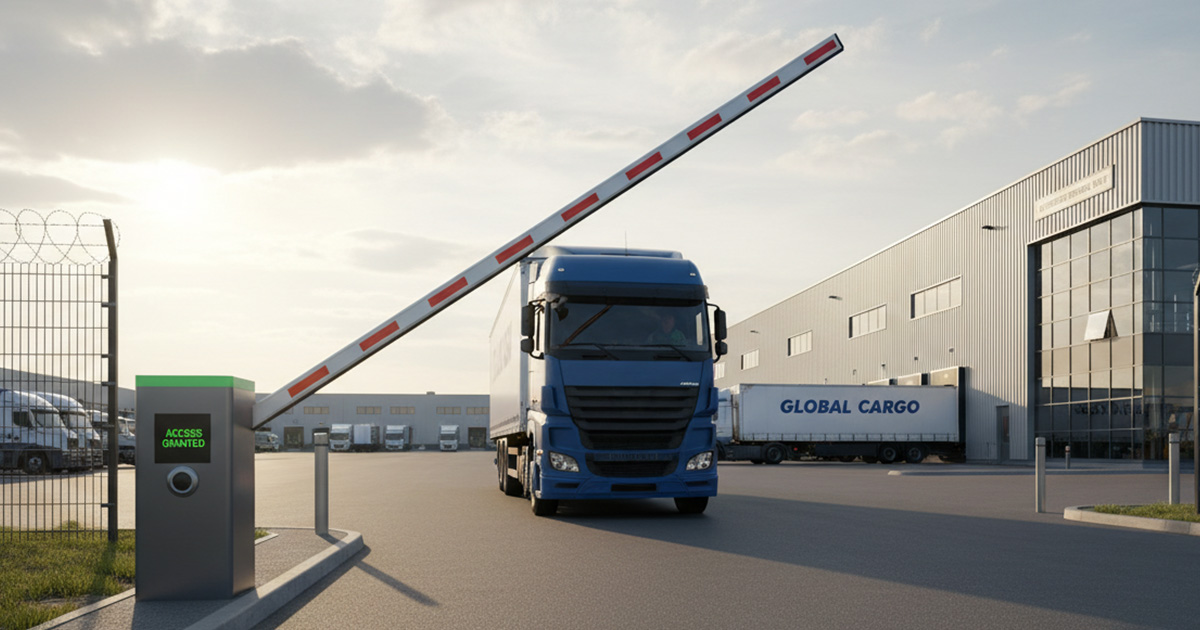
LPR cameras at the gate automatically identify vehicles as they approach. For drivers who have already checked in via mobile, the system matches the license plate to the check-in record and opens the gate automatically. The driver doesn't stop, doesn't interact with anything, and proceeds directly to their assigned dock.
LPR is what turns driver check-in from a fast process into a seamless one. Combined with mobile pre-check-in, it enables a fully hands-free gate experience.
Inspection cameras
Beyond identification, inspection cameras at the gate can validate trailer numbers, DOT numbers, seal presence, and visible damage as the vehicle enters. This data is captured automatically with a timestamped record, replacing the manual walk-around inspection that some facilities require at check-in.
At check-out, the same cameras verify the driver is leaving with the correct trailer before the gate opens.
You don't need a full gate overhaul to get started
Not every facility has an automated gate, and not every operation needs one. Driver check-in can be automated at any scale, even without LPR cameras or lift gates.
A single self-service kiosk at your entrance is enough to eliminate the guard shack workflow. Drivers walk up, check in on the screen, get their dock assignment, and proceed. No gate hardware required. For facilities without a formal gate at all, mobile check-in works the same way. Drivers complete the process on their phone before or upon arrival.
The advanced hardware like LPR cameras, automated gates, and inspection cameras adds speed and automation on top of that foundation, but it's not a prerequisite. Many facilities start with a kiosk or mobile check-in and add hardware later as their operation grows.
What changes when you automate driver check-in
The most immediate impact is speed. Facilities that automate check-in typically reduce the process from 15-30 minutes to under 5 minutes, and for pre-checked-in drivers using LPR, it's effectively zero wait time.
But speed is just the starting point.
Lower labor costs at the gate
Automated check-in reduces or eliminates the need for dedicated gate staff. Instead of paying for guard coverage across every shift, your team is freed up for work that actually requires human judgment. For facilities running 24/7 operations, the labor savings alone can justify the investment.
Consistent data capture
Every automated check-in captures the same information in the same format. No handwriting to decipher, no fields left blank, no inconsistencies between shifts. That data flows directly into your yard management system, giving your team real-time visibility into who's on site, where they are, and how long they've been there.
Better carrier relationships
Drivers remember which facilities are easy to get in and out of. A fast, predictable check-in process makes your facility one that carriers want to service. When capacity is tight and carriers are choosing which loads to prioritize, being known as a facility with a smooth check-in process gives you an edge.
Reduced dwell time and detention fees
Faster check-in means drivers spend less time at your facility overall. Less dwell time means fewer detention fees and more throughput from the same number of dock doors. For more on reducing dwell time, read our post on 5 ways to reduce driver dwell time at your dock.
How driver check-in fits into the bigger picture
Driver check-in doesn't exist in isolation. It's the first step in a broader workflow that includes dock assignment, loading or unloading, documentation, and check-out. When check-in is automated but everything else is manual, you've just moved the bottleneck from the gate to the dock.
The most effective approach is to automate the entire workflow from gate to dock to departure. A yard management system connects check-in to dock scheduling, trailer tracking, and check-out so the entire visit flows without manual handoffs. Drivers move from gate to dock to departure with minimal waiting and minimal coordination from your team.
For facilities still using paper bills of lading, adding eBOL to the workflow eliminates the paperwork delay at the dock that often negates the time saved by faster check-in.
What about driver check-out?
Check-out is the other half of the workflow, and it's just as important to automate. At most facilities, check-out is even more neglected than check-in. Drivers finish loading or unloading and then wait for someone to finalize paperwork, confirm the load, or manually open a gate.
Automated check-out mirrors the check-in process. The driver completes their dock activity, the system confirms the load is complete, and the exit process triggers automatically. If inspection cameras are in place, they verify the driver is leaving with the correct trailer before the gate opens. If you're using eBOL, the digital bill of lading is already signed and stored, so there's no paperwork delay at departure.
For facilities without gate hardware, check-out can be as simple as the driver tapping a button on a kiosk or their phone to confirm departure. The system logs the timestamp and the visit is complete.
Automating both check-in and check-out gives you a clean record of every visit from arrival to departure: who came, when they arrived, how long they were at the dock, and when they left. That data is what drives dwell time reporting, detention fee tracking, and carrier performance analysis.
The bottom line
Driver check-in is one of the simplest parts of your operation to automate and one of the highest-impact changes you can make. The technology exists today to move drivers through your gate in minutes instead of half an hour, with better data, lower costs, and happier carriers.
If your facility is still running check-in through a guard shack or a receptionist window, see how M.Folio automates the full driver workflow from gate to dock to departure.
Roman Reynebeau
Founder, Matilda Technologies
Roman Reynebeau is a software engineer turned founder with nearly two decades of experience building technology for supply chain and fulfillment. Before founding Matilda Technologies, he held leadership roles at Accenture, MacGregor Partners, and Blue Yonder. He was named a Supply & Demand Chain Executive Pro to Know in 2022.