What Is a Yard Management System?
 Roman Reynebeau|Founder, Matilda Technologies|
If you run a warehouse or distribution center, you've probably heard the term "yard management system" or "YMS" come up in conversations about improving dock operations. But depending on who you ask, the definition varies. Some people use it to mean trailer tracking software. Others use it to describe a full gate-to-dock automation platform. The term has evolved as the technology has matured.
A yard management system is software that manages the movement of trucks, trailers, and drivers through your facility's yard, from the moment they arrive at the gate to the moment they leave. It replaces the manual processes that most operations still rely on: guard shack check-ins, radio calls, clipboard-based dock assignments, and paper logs.
What does a YMS actually do?
At its core, a YMS gives you visibility and control over everything happening between your gate and your dock doors. That typically includes a few key functions. For a detailed look at how gate operations can be automated, read our guide on how to automate gate operations at your warehouse.
Driver check-in and check-out
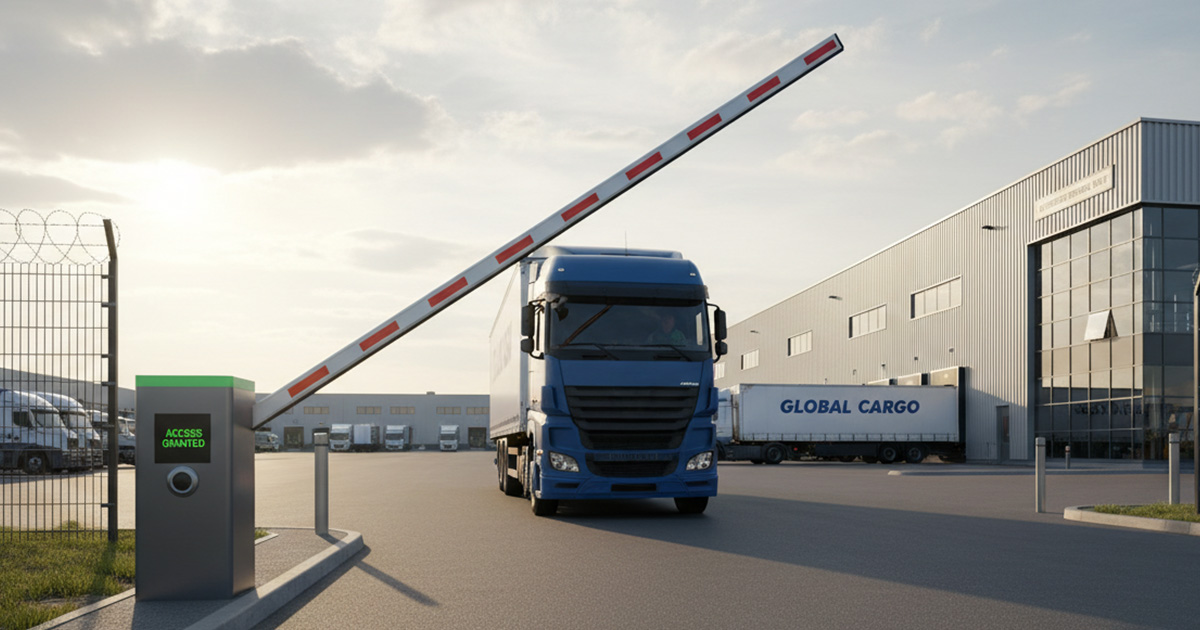
When a driver arrives at your facility, the YMS handles the check-in process. This can happen through a self-service kiosk at the gate, a mobile workflow on the driver's phone, or an automated gate with license plate recognition cameras. The system validates the driver and their load, assigns a dock door, and sends them on their way. The same process works in reverse at check-out.
Without a YMS, this process usually involves a guard shack where someone manually collects information, makes phone calls to the dock to confirm availability, and writes down assignments. On a busy day, that bottleneck can back up traffic into the street.
Dock door assignment
A YMS tracks which dock doors are open, which are occupied, and which loads are expected next. It can assign doors automatically based on rules you define, like load type, carrier, or priority. Your team gets a live view of every door and every appointment, so there are no surprises and no double-bookings.
Yard visibility
One of the most basic but valuable functions of a YMS is simply knowing what's in your yard. How many trailers are on site? Where are they parked? Which ones are loaded and which are empty? Which ones have been sitting for three days? Without a system, answering these questions usually means sending someone out with a clipboard to do a yard check, which is time-consuming and immediately out of date.
Appointment scheduling
Many YMS platforms include dock scheduling functionality, allowing carriers and brokers to self-book appointments against real-time availability. This eliminates the back-and-forth of phone calls and emails that most facilities use to coordinate arrivals. For a deeper look at dock scheduling specifically, read our post on how dock scheduling works.
Why do warehouses need a YMS?
The short answer is that manual yard processes don't scale. They work fine when you're running 20 loads a day out of a single facility. But as volume grows, as you add carriers, as you expand to multiple sites, the cracks show fast.
Dwell time and detention fees
When drivers wait at your facility longer than they should, you pay for it. Detention fees typically range from $25 to $100 per hour, and chronic dwell time damages your reputation with carriers. A YMS reduces dwell time by speeding up check-in, automating dock assignments, and eliminating the manual coordination that causes delays. For more on this topic, read our post on reducing driver dwell time at the dock.
Labor costs
A manual yard operation requires people at the gate, people on radios coordinating dock assignments, and people walking the yard to track trailers. A YMS automates or eliminates most of those tasks, freeing your team to focus on work that actually requires human judgment.
Visibility across facilities
If you operate multiple sites, a YMS gives you a unified view of every yard from one dashboard. You can compare performance across facilities, identify bottlenecks, and standardize processes without relying on each site to report manually.
What's the difference between a YMS and a WMS?
This is one of the most common questions in the space. A WMS (warehouse management system) manages what happens inside the warehouse: inventory, picking, packing, and shipping. A YMS manages what happens outside: gate operations, driver workflows, trailer movements, and dock assignments.
The two systems complement each other. Your WMS knows what needs to ship and what's coming in. Your YMS knows which trucks are on site, which docks are available, and how to get drivers through your facility efficiently. When the two are connected, data flows seamlessly between the yard and the warehouse with no gaps and no manual handoffs.
Most operations that have a WMS but no YMS end up with a blind spot between the gate and the dock. Inventory is tracked precisely inside the warehouse, but the moment it moves to a trailer in the yard, visibility disappears until someone manually updates the system.
What should you look for in a YMS?
We covered this in detail in a separate post, but the short version is: look beyond trailer tracking. The most impactful YMS platforms automate the full driver workflow from gate to dock to departure, not just give you a map of where trailers are parked.
A few specific things to evaluate: whether the system includes hardware (kiosks, cameras, automated gates) or is software-only, how drivers interact with it (the less friction the better), how well it integrates with your WMS and TMS, and whether the vendor handles implementation and ongoing support. For the full breakdown, read what to look for in a yard management system.
The bottom line
A yard management system takes the most manual, reactive part of your operation and turns it into something you can see, measure, and control. The technology has evolved well beyond simple trailer tracking. Modern YMS platforms automate gate operations, streamline dock assignments, reduce dwell time, and give you data to continuously improve.
If your team is still managing the yard with radios, clipboards, and phone calls, the gap between your operation and your competitors who have automated is only getting wider. See how Matilda Technologies approaches yard management to understand what a modern YMS looks like in practice. For a comparison of the leading platforms, see our guide to the best yard management systems in 2026.
Roman Reynebeau
Founder, Matilda Technologies
Roman Reynebeau is a software engineer turned founder with nearly two decades of experience building technology for supply chain and fulfillment. Before founding Matilda Technologies, he held leadership roles at Accenture, MacGregor Partners, and Blue Yonder. He was named a Supply & Demand Chain Executive Pro to Know in 2022.