How to Automate Gate Operations at Your Warehouse
 Roman Reynebeau|Founder, Matilda Technologies|
The gate is the first and last touchpoint for every driver who visits your facility. It's also one of the most manual parts of most warehouse operations. A driver pulls up, waits in line, interacts with a guard or receptionist, hands over paperwork, and waits again while someone confirms their appointment and assigns a dock. On a busy day, that process alone can add 15 to 30 minutes before a driver even enters the yard.
For many facilities, the gate is the single biggest bottleneck in the entire driver workflow. And unlike problems inside the warehouse, gate delays are visible to every carrier and driver who visits your site. They shape your reputation.
The good news is that gate operations can be automated to the point where drivers move through with minimal or no manual interaction. Here's what that looks like in practice.
What manual gate operations actually cost you
The obvious cost is time. Every minute a driver spends waiting at the gate is a minute they're not at a dock getting loaded or unloaded. Multiply that across every load, every day, and the throughput impact is significant.
But there are less obvious costs too. Guard labor is expensive, especially if you're staffing the gate around the clock or across multiple shifts. Turnover in guard positions is high, which means you're constantly training new people on your processes. And manual check-in is inherently inconsistent. One guard may be thorough. Another may wave drivers through without verifying their information. That inconsistency creates security gaps and data quality problems downstream. The same inconsistency applies at check-out, where a driver leaving with the wrong trailer can disrupt multiple shipments and create costly recovery efforts.
Then there's the carrier relationship cost. Drivers talk. If your facility is known for long gate waits, carriers may deprioritize your loads, charge higher rates, or avoid your site during peak seasons. Becoming a shipper of choice starts at the gate.
The building blocks of automated gate operations
Gate automation isn't a single technology. It's a combination of hardware and software that works together to move drivers through the gate without manual intervention. Here are the key components.
License plate recognition cameras
LPR cameras capture the license plate of every vehicle that arrives at your gate. The system matches the plate against expected appointments and automatically identifies the driver and their load. This eliminates the need for a guard to manually collect and verify driver information.
Inspection cameras
Beyond identification, inspection cameras can validate information like trailer numbers and DOT numbers, detect the presence of a seal, and identify visible damage on the trailer. This data is captured automatically as the vehicle enters, creating a timestamped record without anyone needing to walk around the truck with a clipboard.
This is one of the most overlooked opportunities in gate automation. Most facilities either skip trailer inspections entirely or rely on a guard doing a quick visual check that's inconsistent and undocumented. Automated inspection cameras make the process faster, more thorough, and fully auditable. And they work on the way out too, verifying that the driver is leaving with the correct trailer. In a busy yard with dozens of trailers, wrong trailer pulls happen more often than most operations want to admit.
Self-service kiosks
For situations where driver interaction is needed, such as signing documents or confirming shipment details, self-service kiosks at the gate let drivers handle it themselves. No guard required. No app download or account creation required. The driver walks up, completes what's needed, and moves on.
Kiosks are particularly useful for facilities that handle a mix of automated and manual workflows. Regular carriers with appointments can pass through the automated gate without stopping, while walk-in or unscheduled drivers can use the kiosk to check in.
QR codes and SMS communication
Drivers can receive gate instructions and updates via SMS before they arrive, reducing confusion and eliminating the need for someone to direct them once they're on site. QR codes can be used at the gate for quick identification, linking the driver to their appointment and triggering the next step in the workflow automatically.
Automated lift gates
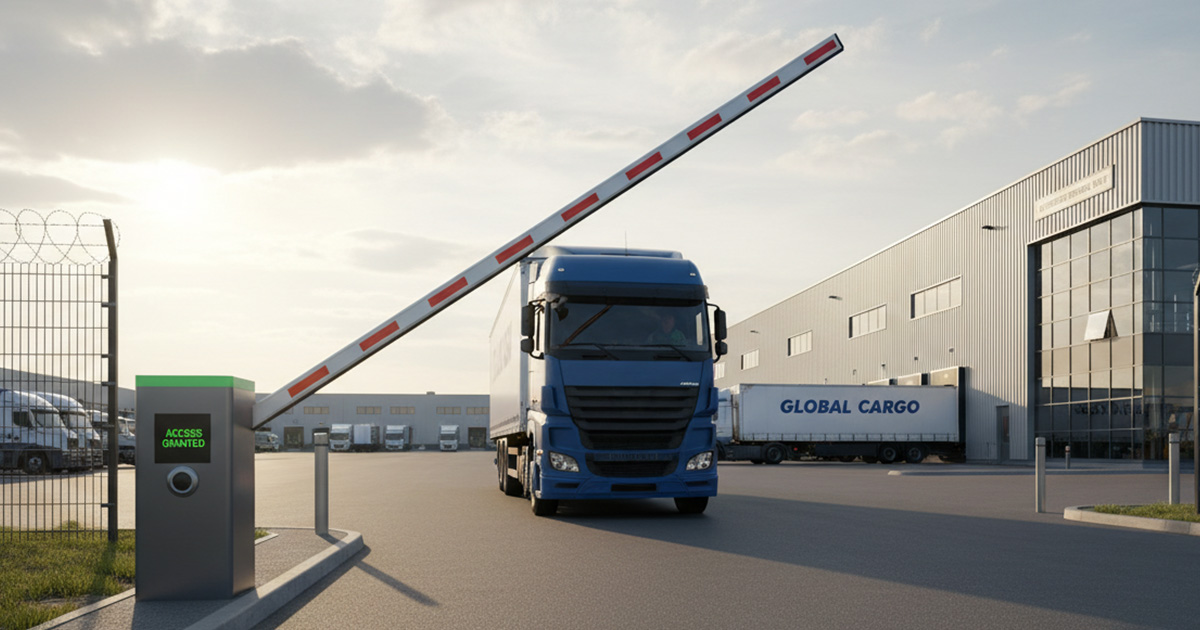
When the system has verified the driver, validated the trailer, and confirmed the appointment, the gate opens automatically. For drivers who check in before arrival (via their phone or a link sent by SMS), this process is completely hands-free. They pull up, the cameras do their work, and the gate lifts without the driver needing to stop or interact with anything.
For drivers who haven't checked in ahead of time, the process is still fast. They check in at a self-service kiosk or on their phone when they arrive. Once check-in is complete and the system has validated the vehicle, the gate opens. Either way, no guard is needed.
What the full workflow looks like
When all of these components are connected through a yard management system, the gate experience changes completely.
A driver who has checked in ahead of time approaches the facility. LPR cameras identify the vehicle and match it to an expected appointment. Inspection cameras capture the trailer number, DOT number, seal status, and any visible damage. The system validates everything automatically. The gate opens. The driver receives a dock assignment via SMS or on a display at the gate. They drive directly to their assigned dock without stopping, waiting, or talking to anyone.
For drivers who haven't checked in ahead of time, the experience is nearly as fast. They check in on their phone or at a kiosk at the gate, the cameras run their validations, and the gate opens. The difference is one extra step, not a 20-minute wait at a guard shack.
At check-out, the process works in reverse. The system confirms the load, verifies that the driver is leaving with the correct trailer, captures outbound inspection data, and opens the gate. The entire visit is documented with timestamps, photos, and a complete audit trail.
Compare that to the traditional process: wait in line, talk to a guard, hand over paperwork, wait for a dock assignment, get directed by radio, and repeat the whole thing on the way out. The time savings are measured in hours per day across a busy facility.
When does automation make sense?
Not every facility needs a fully automated gate. A small warehouse with 10 loads a day and a single gate may do fine with a guard and a clipboard. The question is whether your current process is creating bottlenecks, costing you money, or damaging carrier relationships.
A few signals that it's time to automate: drivers regularly queue at your gate during peak hours, your guard staff is a significant line item in your operating budget, you've had security incidents related to unauthorized access, you can't produce consistent records of who entered and exited your facility, or carriers have told you that your facility is slow to get in and out of.
If any of those sound familiar, the gate is likely where you'll see the fastest return on investment from yard automation. For a broader look at how a YMS fits alongside your WMS, read our post on YMS vs. WMS.
The bottom line
The gate sets the tone for every visit to your facility. A slow, manual gate process creates a ripple effect that impacts dwell time, dock utilization, carrier satisfaction, and labor costs. An automated gate eliminates the bottleneck and gives you a documented, consistent, auditable process for every vehicle that enters and leaves your yard.
If you're exploring gate automation as part of a broader yard management strategy, see how M.Folio by Matilda Technologies approaches yard management. For a broader overview of what a modern yard management system includes, read our guide on what a yard management system is. For a comparison of the leading platforms, see our guide to the best yard management systems in 2026.
Roman Reynebeau
Founder, Matilda Technologies
Roman Reynebeau is a software engineer turned founder with nearly two decades of experience building technology for supply chain and fulfillment. Before founding Matilda Technologies, he held leadership roles at Accenture, MacGregor Partners, and Blue Yonder. He was named a Supply & Demand Chain Executive Pro to Know in 2022.